
You registered a domain with your city and your service in it, launched the site, and the map results still show the same three competitors. That is usually when owners start asking about the importance of domain name for local SEO, after the money is already spent. The real cost is rarely the registration. It is the rebrand, the redirects nobody mapped, and the signage carrying a name the business has outgrown.
We work through this decision with local operators, and the useful answer is precise. Five signals move local rankings. Your domain touches some of them, cannot touch others, and often gets credit for results it did not produce. Below is each signal, what the name contributes to it, and how to decide what to do with yours.
What Your Domain Name Actually Does for Local Search
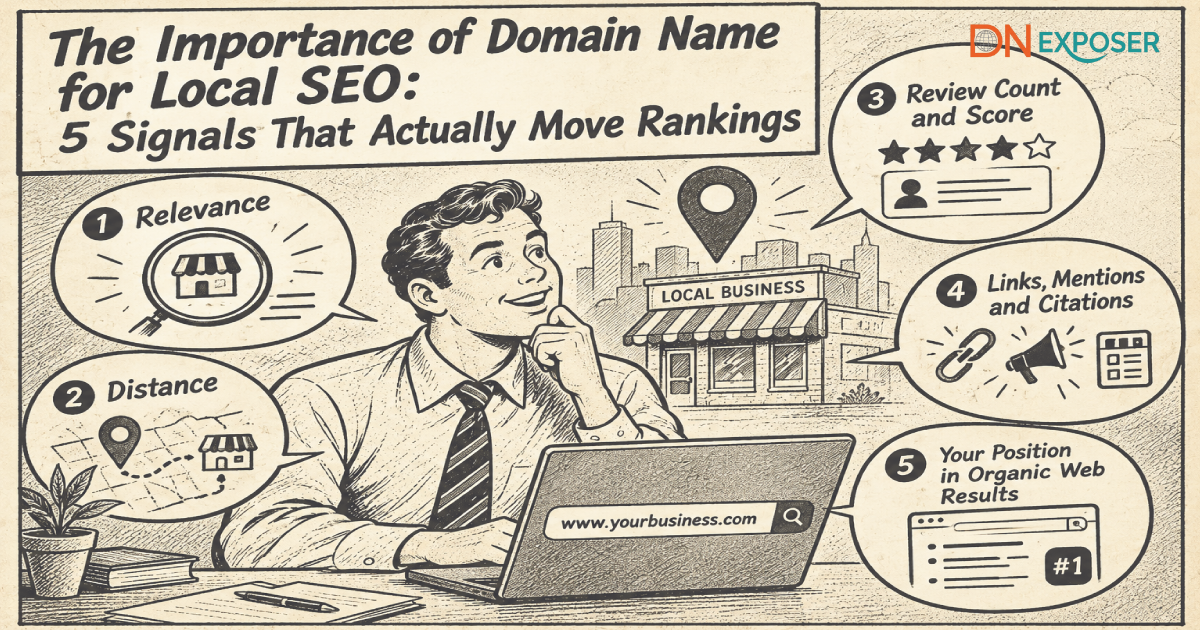
Your domain name is a supporting signal in local search, not a ranking lever. It adds context, and a clear name reinforces recall, citations and direct visits. Google documents local results as driven by relevance, distance and prominence, and your business profile, reviews, links and website feed those three far more than the name does.
According to Google Business Profile Help on how local ranking works, those three factors combine to determine which businesses appear. The same page breaks prominence into several components. We separate them below, which gives the five signals that actually move local rankings.
5 Signals That Actually Move Local Rankings
Signal 1: Relevance
Relevance is how closely your business matches what someone searched. It comes from your profile categories, your service descriptions and the pages on your site. A domain containing your service or market adds context, the way a page title does, but a thin site does not become relevant because of its name. Domain role: small. Per Google Search Central, LocalBusiness structured data, a markup vocabulary maintained by Schema.org that labels your name, address and location for machines, states explicitly what a domain only implies.
Signal 2: Distance
Distance is measured between the searcher and your real business location. We state this plainly because it is the costliest misunderstanding we see. Domain role: none. A city in your domain changes no coordinate, no service area and no map pin.
Signal 3: Review Count and Score
Google's local ranking documentation names review count and positive ratings as part of prominence. Reviews are earned through service and through asking. Domain role: none directly. No name produces a review.
Signal 4: Links, Mentions and Citations
Prominence also draws on what the web says about you: links, articles and directory listings. A citation is any listing of your business name, address and phone number on another site. Domain role: real. A name customers can hear once and spell correctly gets cited accurately, while a confusing one produces variations that split your signals across the web.
Signal 5: Your Position in Organic Web Results
Google notes that where your website ranks in regular web results also feeds prominence, so standard SEO practice applies to local businesses. Domain role: indirect. The domain is the container for your site's history and links. The quality of what it contains matters far more than the words in it.
Why the Importance of Domain Name for Local SEO Is Easy to Overstate: 3 Things That Do Not Move Rankings
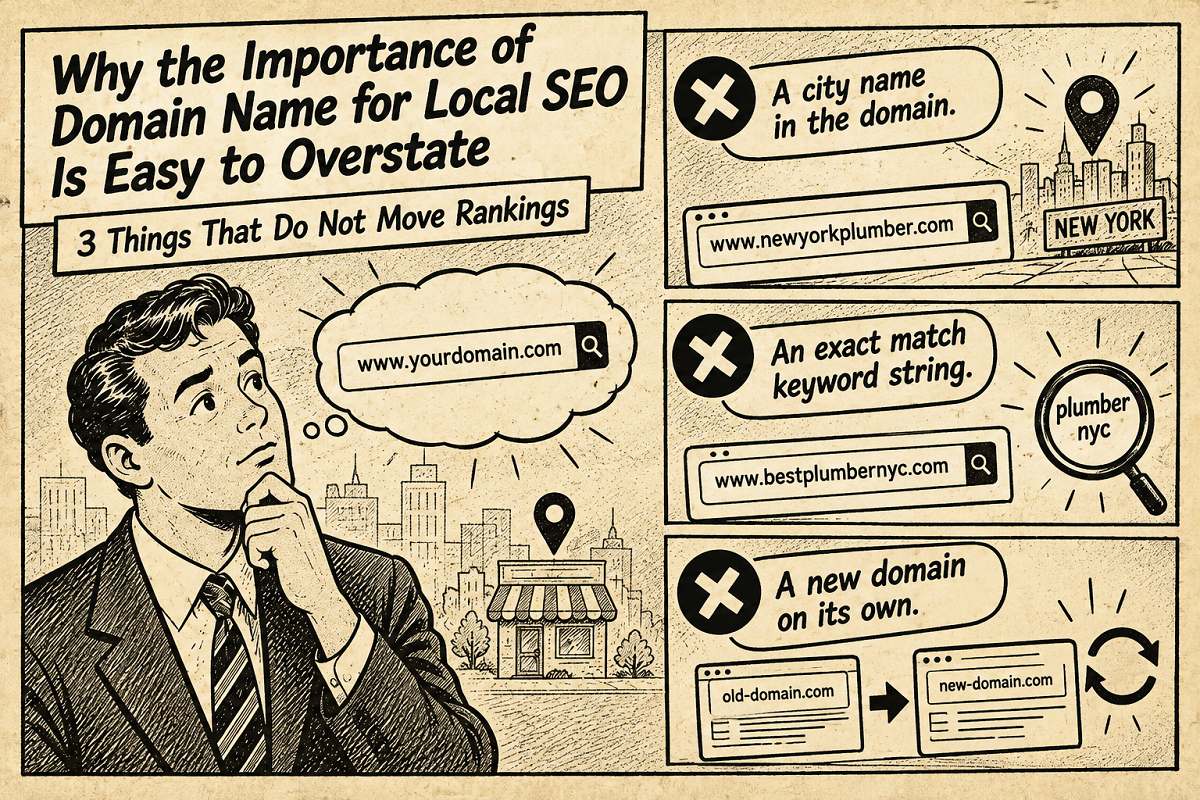
The domain is the one asset an owner picks alone, in an afternoon. It feels like the lever because it is the lever within reach. We understand the instinct, and we still argue against acting on it for these three reasons.
- A city name in the domain. Distance is calculated from where you are, not from what your address bar says.
- An exact match keyword string, meaning a domain that repeats a search phrase word for word. It does not replace the relevance built by your profile and your pages.
- A new domain on its own. Switching boosts nothing. It starts a migration that can lose existing signals if handled poorly.
City Domain or Brand Domain: The Trade-Off for a Local Business
This is a business decision, not an SEO one. We ask whether a descriptive domain, one that states your city or service, returns enough practical value to justify the limits it puts on the brand.
What Works in Practice
- The name states the service area before a first-time visitor reads a word, which shortens the trust decision.
- It survives the phone test: easy to say on a call, easy to read on a truck at driving speed.
- For a single-location business with no expansion plan, it matches how customers already describe you.
Where This Approach Falls Short
- A second location turns a city name into a liability, and the rebrand usually costs more than the domain did.
- A new service line the name does not mention creates the same problem on another axis.
- A domain chosen mainly for its city keyword is harder to defend as a brand and harder to distinguish from competitors built the same way.
What a Domain Change Costs in Local Visibility
Price the operation, not just the name. Google Search Central treats a domain change as a site move with URL changes, requiring an old-to-new URL map, server-side redirects, updated internal links and monitored traffic. Locally, we add your business profile link, every directory citation, review listings, social profiles, email addresses and analytics settings. An incomplete citation update loses more visibility than the migration itself.
How to Choose a Local Business Domain: Four Checks Before You Register
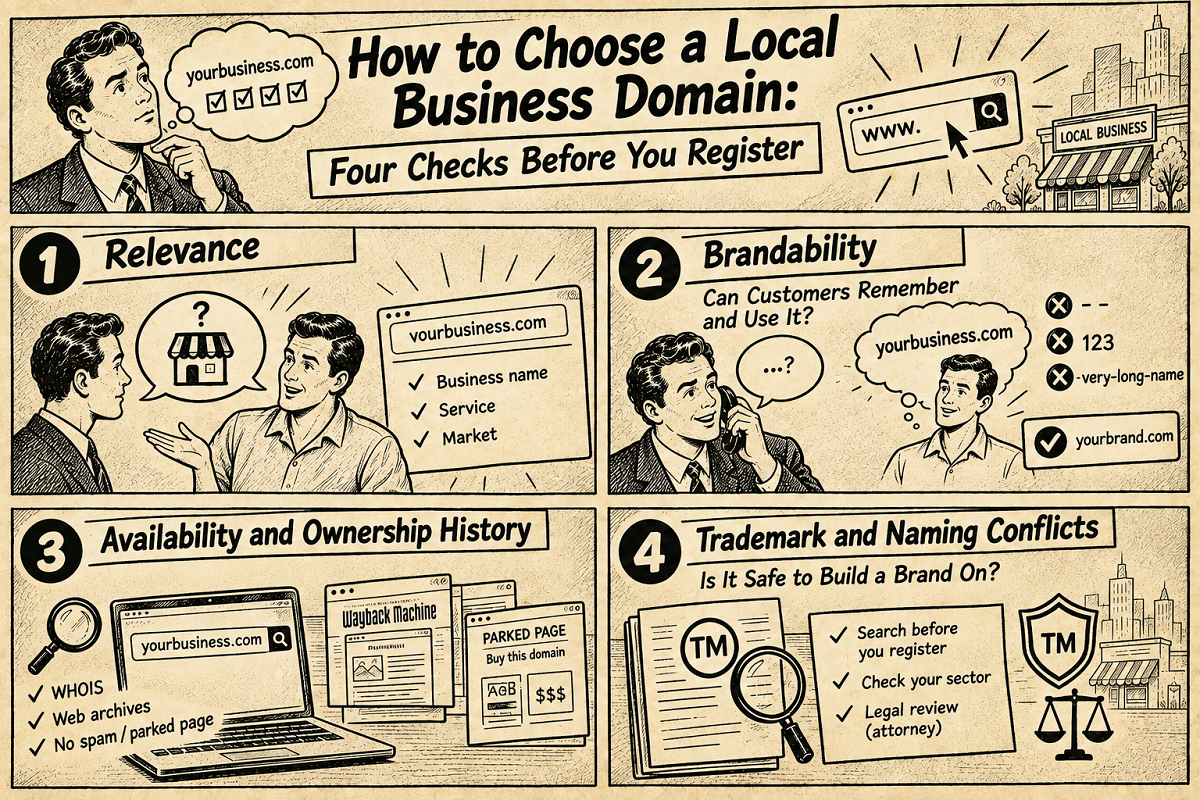
We run these four checks in order, and we stop at the first one that fails. Each check answers a different question: whether the name fits the business, whether customers can use it, whether the domain carries a hidden past, and whether the name is safe to build a brand on. Skipping one is how owners end up paying for a domain twice.
Relevance: Does It Clearly Match the Business?
A relevant domain tells a customer who you are or what you do without a subtitle. That can come from your business name, your service, or your market, but it does not require all three packed into one string. We see owners force the full phrase into the name, service plus city plus a qualifier, and end up with something too long to say and too generic to remember.
The test we use is simple. Show the domain to someone who does not know your business and ask what they think you do. If the answer is roughly right, the name is relevant enough, and your profile categories, your pages and your structured data will carry the rest of the relevance signal. If the answer is wrong or blank, the name is working against you before anyone reaches the site.
Brandability: Can Customers Remember and Use It?
A local business domain lives mostly offline: on a truck, a yard sign, a business card, a phone call. That is why we test it out loud before we test it on a screen. Say the name once to someone and ask them to type it. Every hesitation on spelling is a customer who lands on the wrong site or gives up.
Hyphens and digits fail this test almost every time, because a listener has to ask whether it is the number or the word, and whether there is a dash. Length matters for the same reason: every extra syllable is another chance to mishear. Then ask the growth question. If you add a second location or a second service line, does the name still describe the business, or does it start describing only part of it? Owners who conclude that a brand-first name fits better can review our curated brandable domain marketplace.
Availability and Ownership History
Local business domain name availability is the easy part of the check. The harder part is history. A domain that looks available, or that is offered to you, may have hosted content, redirected elsewhere, or been used for spam before you found it, and that past can follow it into search results and into email deliverability.
We look at three things before any registration or acquisition. First, the WHOIS record, the public registration data showing when the domain was registered and, where not privacy-protected, by whom. Second, archived versions of the site in public web archives, to see what it actually hosted. Third, whether the domain currently resolves to a parked page, meaning a placeholder page with ads or a sale notice, which usually signals an owner open to an offer. If you intend to buy a local domain from its current owner, market conditions and the seller's own position govern the price and the outcome. Nobody can guarantee either one in advance.
Trademark and Naming Conflicts
A domain registration and a trademark are two separate systems, and one says nothing about the other. A registrar will sell you any available domain without checking whether the name conflicts with a business already using it. Availability tells you the string is free. It does not tell you the name is safe to put on your signage.
The pressure on names is real: according to the USPTO's Fiscal Year 2025 Agency Financial Report, the office received 824,192 trademark application classes in fiscal year 2025, up 57,054 from the prior year. We read that as one more reason to check a name before it goes on a sign.
We recommend searching the name in your sector before committing to it. The USPTO publishes trademark search and registration guidance, and a search there is a starting point, not a conclusion, since federal registration is not the only source of trademark rights. Clearance, conflicts and disputes belong with an attorney. We flag the risk. We do not clear the name.
The Next Step for Your Local Domain Decision
Our rule is short. If your domain is established and cited correctly, keep it and invest in the five signals above. Change it only for a clear branding or strategic reason, and only if you can manage the migration properly.
If you are weighing that trade-off now, request a domain name consultation and we will review it with you against these four checks. For the full framework, read our guide to choosing a local business domain name without a costly rebrand.


