- What a Local Business Domain Name Is, and What It Actually Decides
- The Criteria We Apply Before We Approve a Name
- City in the Domain or Brand Only: The Trade-Off
- What Your Domain Name Does for Local Rankings, and What It Does Not
- A Practical Decision Process: From 20 Names to One Domain
- How to Check Availability and Register the Name, Step by Step
- When the Name You Want Is Already Registered
- Five Mistakes We See Most Often on Local Domains
- Frequently Asked Questions
Most owners we work with pick a local business domain name in an afternoon, under pressure, because the sign company needs it or the truck wrap is already scheduled. The name gets registered, printed and spoken to customers for years. Then the business opens a second location, adds a service line, or hears from an attorney about a name that was already in use, and the domain that felt obvious becomes the most expensive small decision on the books. A rebrand is not a domain fee. It is signage, vehicles, print, reviews, citations and the customers who still type the old name. This guide gives you the screening process we use, in the order we use it, so the name you register this month still fits the business you have in five years.
What a Local Business Domain Name Is, and What It Actually Decides
A local business domain name is the web address a local company owns and controls, such as the name that appears after the www in your website address. It decides four things: what customers say out loud, what they remember, whether they trust the address at first contact, and whether the name still works if the business grows. It does not decide your search rankings.
We separate those four jobs because owners usually conflate them with a fifth one that does not exist. The domain is an identity asset. It is the string a customer repeats to a neighbor, types from memory after seeing it on a vehicle, and reads at the top of an estimate. Every one of those moments is a branding moment, not a ranking moment.
Trust is the part owners underestimate. A first-time customer comparing three contractors has almost no information, so small signals carry more weight than they should. An address that matches the business name on the invoice removes one question. An address that does not match creates one.
Evolution is the part they underestimate more. The domain is the only branding element that is almost impossible to change quietly. You can reprint a card and repaint a van. You cannot make thousands of past customers, directories and backlinks point somewhere new without loss. We treat the domain as the anchor the rest of the brand is tied to, which is why we screen it harder than the logo.
The Criteria We Apply Before We Approve a Name
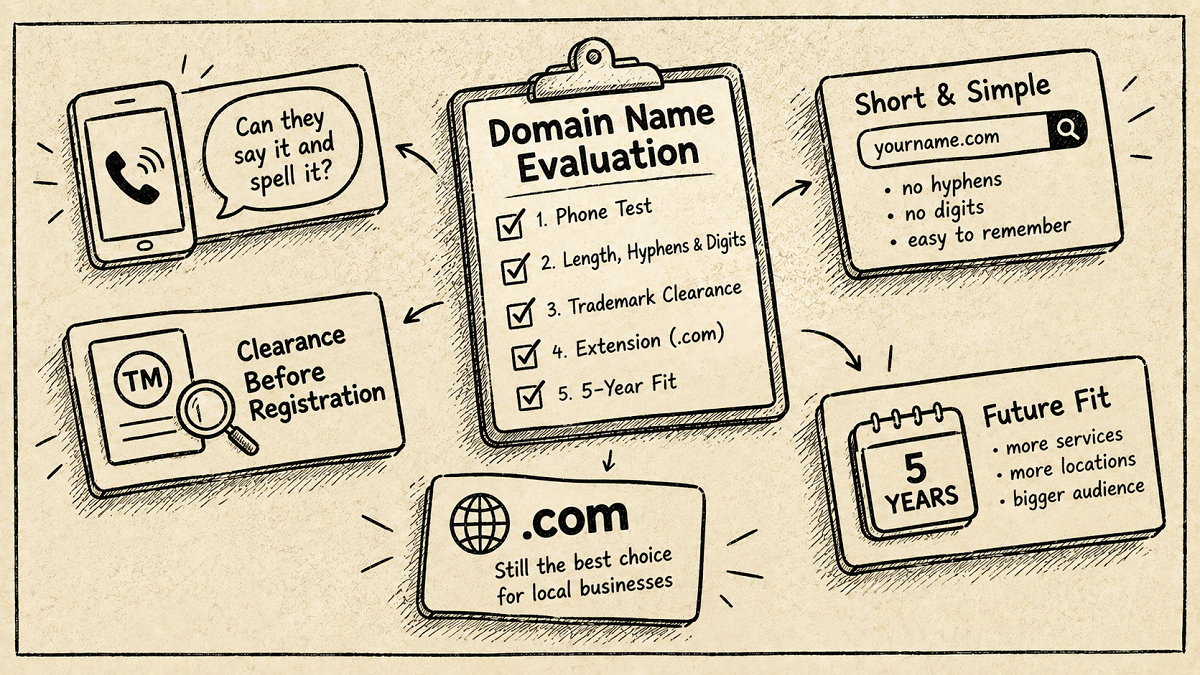
We do not evaluate one name. We evaluate a list, against the same five criteria, in the same order, and we drop candidates as early as possible because later checks cost more time. The order matters: a name that fails the phone test is not worth a trademark search, and a name that fails a trademark search is not worth an availability check.
The Phone Test: Can It Be Said Once and Spelled
Say the name out loud to someone who has never seen it written. Ask them to write it down. If they ask a question, the name failed.
Local businesses live on spoken referral far more than national brands do. A customer tells a neighbor, a dispatcher gives the address over a call, a technician says it at the door. Every clarification in that exchange is friction, and friction at the referral stage is the most expensive kind because you never see it happen.
The common failures are predictable. Names with two plausible spellings, such as a word that can be written with or without a final letter. Names that depend on a silent letter. Names that only work when you see the capital letters, because a domain does not have capital letters. If you need to say "that is with a K" more than once, choose a different candidate.
Length, Hyphens and Digits
Shorter names are easier to type from memory, easier to fit on a sign, and harder to mistype. We aim to keep a local name under roughly fifteen characters, and we prefer one to three syllables, because syllable count predicts recall better than letter count does.
Hyphens and digits are where local domains break most often. A hyphen is invisible when spoken, so the customer has no way to know it exists. A digit is ambiguous, because "four" can be written as a word or a numeral and the listener has to guess. Both push the customer into a search engine to find you, and once they search, they see your competitors.
There is a real trade-off here. A hyphenated version is often available when the clean version is not, and it costs a registration fee instead of an acquisition. We still advise against it for a business that depends on spoken referral.
Trademark Clearance Before Registration, Not After
Availability and legal clearance are two different questions. A domain being unregistered means nobody has taken that string. It says nothing about whether another business already holds rights to that name in your sector.
This is not a formality. Under ICANN's Uniform Domain-Name Dispute-Resolution Policy, a registrant represents that registering the domain will not infringe the rights of a third party, and disputes over names registered in bad faith are handled through that process. The obligation sits with the person who registers the name, not with the registrar.
The practical step is to run a search of existing marks before you commit, using the USPTO trademark search, and to look specifically at the sector your name points to rather than at identical strings alone. We run this check on our shortlist, never on the single name an owner has already fallen in love with. Clearance opinions and any actual dispute belong with a trademark attorney, and nothing in this article replaces that advice.
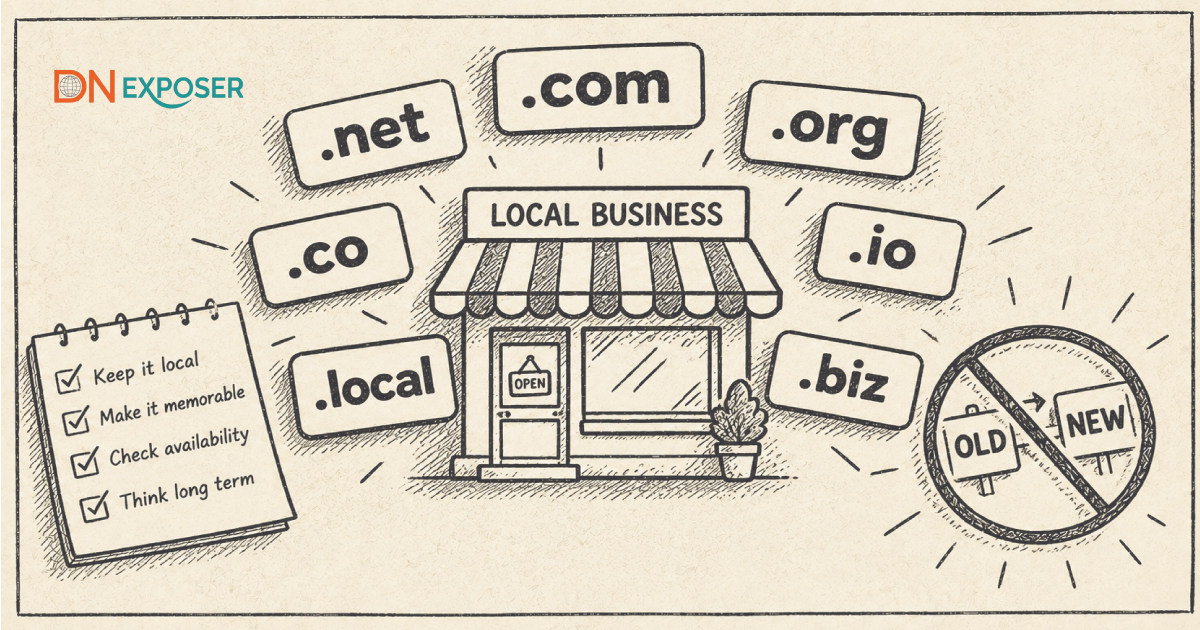
Extension: What .com Still Carries for a Local Buyer
The extension is the part after the dot, also called the top-level domain or TLD. For a local business, the practical question is what a customer assumes when they hear the name without seeing it.
What works in practice:
- .com is the default a customer types when they half-remember your address, which means a competitor holding the .com of your name captures traffic you paid for;
- it removes a spoken step, because you rarely have to say the extension out loud for people to get it right;
- it ages well, since it carries no implication about location, size or service line.
Where this approach falls short:
- the .com of a clean, short name is frequently registered already, so insisting on it can mean either a weaker name or an acquisition budget;
- an extension is not a performance guarantee, and no extension ranks a business by itself;
- some newer extensions carry registry-level eligibility rules or renewal pricing that differ from legacy extensions, so the terms deserve reading before you commit
Our position is that .com stays the first choice for a local business that relies on word of mouth, and that a strong name on another extension beats a weak name on .com.
The Five-Year Fit Test
Take each surviving candidate and describe the business you intend to run in five years. A second location. A new service line. A different customer segment. Then read the domain again.
Three patterns fail this test regularly. Names locked to one city. Names locked to one service, such as a single trade that the owner later expands beyond. Names locked to a founder's surname when a sale or a partnership is plausible.
City in the Domain or Brand Only: The Trade-Off
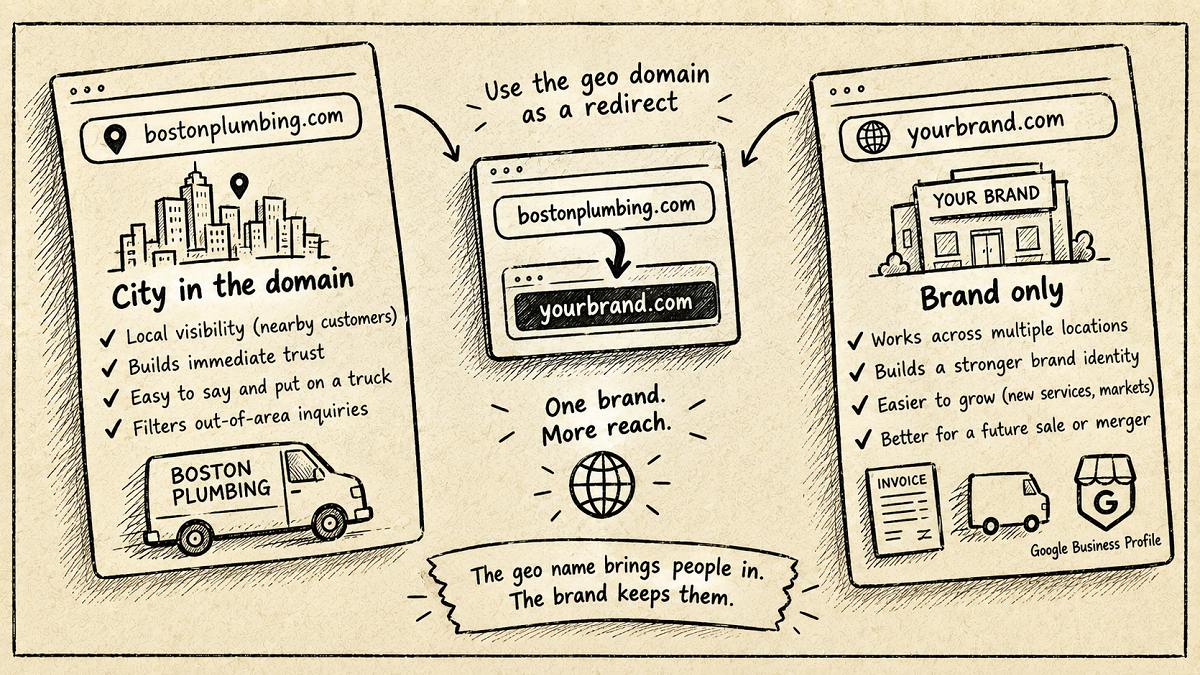
This is the question we get most often, and the answer is conditional, not binary. The pressure to put the city in the domain is a visibility pressure. The owner wants to be found by people three miles away and the city name looks like the shortest route there.
What works in practice:
- the name states the service area before the visitor reads a word of copy, which shortens the trust decision for a first-time customer;
- it is easy to say on the phone and easy to put on a truck, which matters more for a trades business than any ranking argument;
- it filters inquiries, because people outside the area self-select out before they call.
Where this approach falls short:
- a city in the domain fixes the business to one market, and a second location turns the name into a liability rather than an asset;
- it caps the business at the size of one geography in the mind of every customer who reads it, including commercial clients who operate regionally;
- an exact match city and service string is harder to defend as a brand, and harder to distinguish from competitors using the same construction;
- if the business is ever sold or merged, the name transfers a geography rather than an identity.
Brand domain or city domain: work it through
Four questions about the business you actually run. The answer is conditional, so the result states the reasoning, not a verdict on its own.
Our position is that the brand domain is the primary address and the geo version is a secondary asset that points to it. The reasoning is that the two names are being asked to do different jobs, and owners usually ask one name to do both.
The brand domain carries the identity. It is what goes on the invoice, on the vehicle and in the Google Business Profile, and it is the one string that has to survive a second location, a new service line or a change of positioning. The geo version carries reach. It is the string someone types or recognizes when they are thinking in terms of a city and a service rather than in terms of your company name.
A redirect resolves the conflict. A redirect is a domain that forwards every visitor who arrives on it to the main site, so the geo name can appear in a local campaign, on a regional listing or on a piece of print aimed at one market, while every visit still lands on the brand. The identity stays in one place. The capture happens in several.
Two limits belong with that recommendation. A redirected domain is a traffic and recall instrument, not a ranking instrument, and holding a second name does not create local visibility by itself. And the trademark position of a geo string is checked the same way as the primary name, with clearance belonging to an attorney, because a city added to a protected term does not neutralize the underlying right.
The practical sequence is to secure the brand domain first, confirm it against the criteria above, then decide whether a city-and-service version is cheap and obvious enough to hold as a redirect. Registering the geo name first is the order that produces a rebrand.
What Your Domain Name Does for Local Rankings, and What It Does Not
Owners are told constantly that putting the city and the service in the domain will rank them locally. We want to be precise about where that belief breaks.
Google states that local results are determined by relevance, distance and prominence, and explains those factors in its Google Business Profile guidance on local ranking. Relevance is how well your profile and site match what someone searched. Distance is how far you are from the searcher or the searched area. Prominence is how well known the business is, which includes reviews, citations and web presence. The domain string is not one of those three factors.
Industry research confirms this distinction. Data from the BrightLocal Local Search Ranking Factors study shows that core Google Business Profile signals such as customer reviews, primary category selection, and proximity drive over 32% of Local Pack ranking performance, whereas exact-match domain keywords account for less than 2%.
That does not make the domain irrelevant to how you perform. It contributes indirectly, through the things it makes easier or harder: name consistency across your profile and directories, branded searches when customers look for you by name, and click behavior when your result appears next to four competitors. Those are brand effects arriving through the front door, not a keyword effect.
The practical consequence is a budget decision. An owner who believes the domain is the lever spends their effort on the string and neglects the profile, the reviews and the location pages, which is where local visibility is actually contested. We would rather see a brandable domain and a complete, well-reviewed profile than an exact match string and a thin profile.
A Practical Decision Process: From 20 Names to One Domain
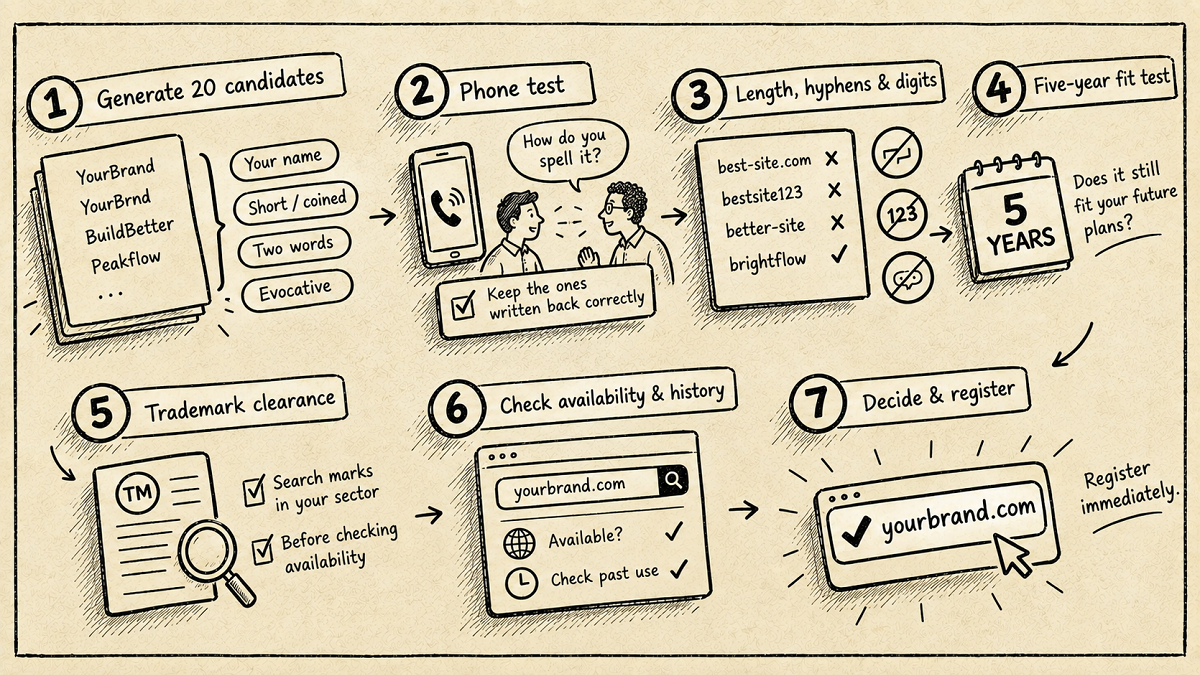
Here is the sequence we run, in order, because each stage is cheaper than the one that follows it.
- Generate twenty candidates, not three. Write them in four groups: your business name as-is, a shortened or coined version of it, a compound of two plain words that describe the outcome you deliver, and an evocative word with no literal meaning in your trade.
- Run the phone test on all twenty. Read them aloud to two people who do not work with you. Keep the ones written back correctly the first time. This usually removes half the list in ten minutes.
- Apply length, hyphens and digits. Drop anything hyphenated, anything with a numeral, and anything that needs more than three syllables to say.
- Apply the five-year fit test. Read each survivor against the business you intend to have, not the one you have.
- Run trademark clearance on the shortlist. Search existing marks in your sector before you check availability, not after, because a name you have already registered is a name you will argue to keep.
- Check availability last, and check history with it. A previously used domain can carry a past you did not choose.
- Decide, then register immediately. Shortlists leak. Names discussed publicly get registered.
Screen your candidate names
Paste your candidates, one per line. This applies the mechanical criteria from this guide: length, hyphens, digits and approximate syllable count. It does not check availability, ownership or trademark rights, and it produces no valuation.
Candidate names, one per lineAvailability, registration history and trademark clearance are checked after this stage, not during it. Clearance opinions and any dispute belong with an attorney.
If you would rather not run this alone, we do exactly this process with owners in our brand naming consultation, and we keep a small set of screened brandable names in our curated brandable domain marketplace for owners who want to start from names that already cleared these criteria.
How to Check Availability and Register the Name, Step by Step
Checking local business domain name availability is mechanical once your shortlist is legally screened. We do it in this order.
First, look up the registration record. A public lookup, historically called WHOIS and now served through registration data services, tells you whether a name is registered and, in many cases, when it was created and when it expires. An unregistered name is available to register. A registered name is not unavailable, it is owned, which is a different situation with a different path.
Second, check the history of any name that has been registered before. Look at how it was previously used and whether the prior deployment was spam, adult content or anything that would follow the name to you. A clean slate is worth more than a slightly better string.
Third, register the name with an accredited registrar of your choice, in the legal name of the business rather than an employee or an agency. Ownership of a domain is defined by the registrant record, and we have seen owners discover years later that a former web developer is the registrant. Registrant rights, transfers between registrars and the transfer process are governed by ICANN's transfer policy, which is worth reading once before you sign anything.
Fourth, set renewal to automatic and put the expiration date in the same calendar you use for insurance and licenses. Keep the registrar account under a business email address that survives staff turnover, and enable two-factor authentication on it. A lapsed renewal is the single most preventable way to lose a working local domain.
Fifth, register the obvious defensive variants only if they are cheap and genuinely obvious, such as a common misspelling customers already make. This is protection, not accumulation.
When the Name You Want Is Already Registered
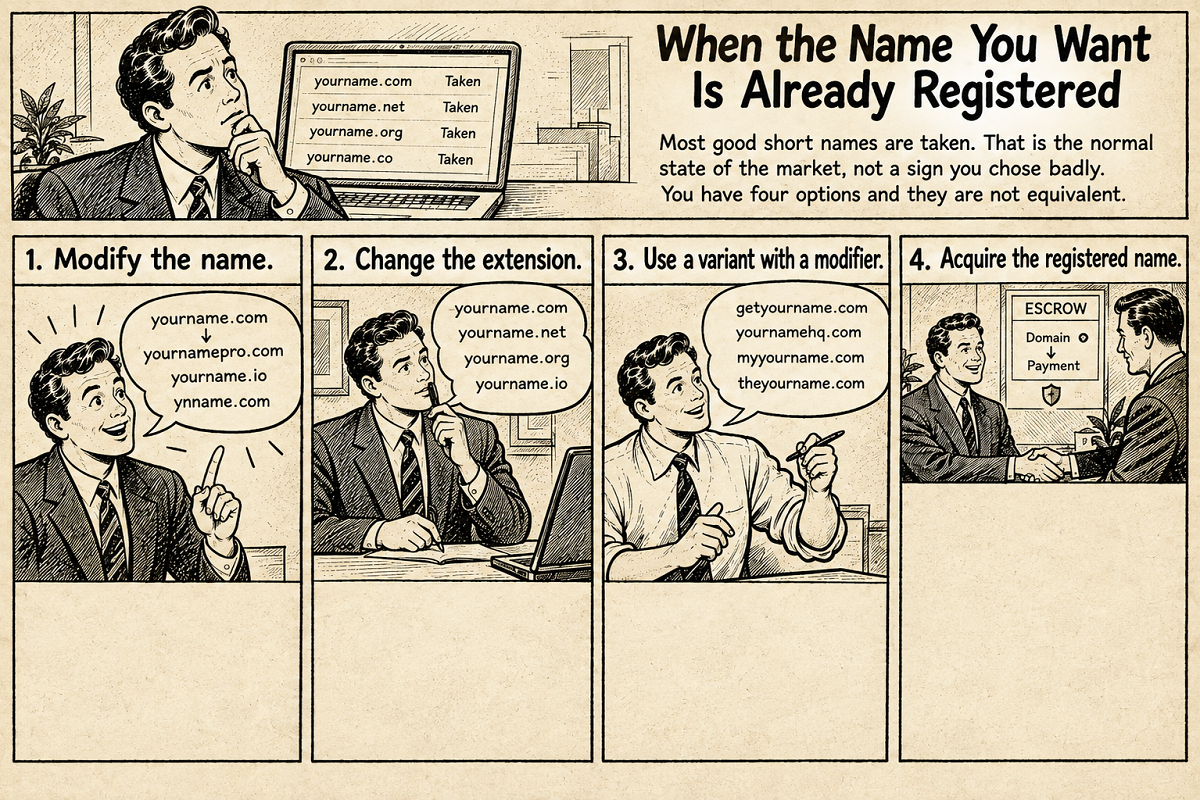
Most good short names are taken. That is the normal state of the market, not a sign you chose badly. You have four options and they are not equivalent.
Modify the name. Add or change a word, shorten it, or coin a variant that keeps the sound and frees the string. This is the cheapest option and it often produces a better brand than the original candidate.
Change the extension. Keep the name and take a different TLD, accepting the trade-offs listed earlier, including the fact that the .com holder may benefit from your marketing.
Use a variant with a modifier. A short prefix or suffix that reads naturally when spoken. Test the result against the phone test again, because modifiers frequently fail it.
Acquire the registered name. Domains already registered can often be purchased from their owner through the aftermarket, meaning the secondary market for existing domains, with the transfer handled through escrow so that money and the domain change hands under a neutral third party. What a name costs is not fixed. Market conditions, comparable transactions for similar names and the seller's own position govern the outcome, and no one can guarantee a price, an acquisition or a timeframe before an owner has been approached. Any trademark question raised by the name belongs with an attorney before money moves. If you want that approach handled professionally, this is what our domain brokerage service does, and the valuation reasoning behind it is set out in our guide to what makes a domain name brandable.
Five Mistakes We See Most Often on Local Domains
Choosing purely for keywords. Packing the city and the service into the string, in the belief that it ranks, produces a name that is hard to say, hard to own and indistinguishable from four competitors using the same construction.
Skipping the trademark check. The registrar will sell you a name that another business has rights to. The check is yours to run, and running it after the vehicle wrap is printed is the expensive order of operations.
Over-localizing. Encoding a neighborhood or a city into the identity of a business that is likely to serve a wider area within a few years, then paying for the correction in signage, print and lost recognition.
Sacrificing memorability for availability. Taking the hyphenated, misspelled or elongated version because it was free, and spending the next decade spelling it out loud on every call.
Treating registration as the finish line. No autorenewal, registrant record in a contractor's name, no control of the registrar account, no record of the expiration date. The name was chosen well and lost administratively.
Choose the Name Once, With the Criteria Stated
The owners who avoid a rebrand are not the ones with better instincts. They are the ones who screened a list instead of defending a favorite, checked trademarks before registering instead of after, and read the name against the business they intended to build rather than the one they had that week.
If you want that process run with you, on your shortlist and in your market, request a domain name consultation. We work through the criteria in this guide against your actual candidates: the phone test, length and construction, trademark screening before commitment, extension fit and the five-year test. You leave with a shortlist you can register, and the reasoning behind why each name survived or did not.