
How to Find Brandable Domain Names for Startups: The Short Answer
To find brandable domain names for startups, write a naming brief first, generate candidates with more than one naming approach, then eliminate them in a fixed order: pronunciation, spelling, federal trademark screening, registration history, and acquisition cost. You buy last. Elimination is what turns a long list into a usable shortlist.
We keep that order for one reason. Each step costs more than the one before it. Saying a name out loud costs nothing. A preliminary trademark search costs an hour of attention. Acquiring a name someone already owns costs whatever the current owner decides it costs.
A brandable domain name is a coined, compound or evocative name that does not literally describe what you sell, which is precisely what allows it to function as a brand later. We set out the full criteria in our guide to what makes a domain name brandable.
Step 1: Write the Naming Brief Before You Open a Single Tool
Founders rarely lack ideas. They lack a rule that tells them which idea to throw away. A naming brief is that rule, written down before the ideas arrive so that taste does not get to vote twice.
We ask for the brief in one page. It names the sector the brand points to, the buyer, the register the name should sound like, and the constraints below. Without it, generation produces volume and nothing to measure volume against.
The Five Constraints to Fix Before You Generate Anything
- Length. Set a ceiling in characters and hold it. Short names are easier to say, type and put on a business card.
- Syllables. One to three. Past that, people shorten the name for you, and they rarely shorten it well.
- Extension. Decide which top-level domain, meaning the part after the final dot, you will accept before you fall for a name that only exists on one you will not.
- Spelling risk. No hyphens, no digits, no deliberate misspelling that forces a correction on every phone call.
- Sector signal. Decide whether the name should read as sector-neutral or point clearly to one sector. Both work. Undecided does not.
Founders who want a second opinion on the brief itself can bring it to our brand naming consultation before the shortlist exists.
Step 2: Generate Creative Domain Names for Startups With Four Approaches, Not One
A single generation method produces a single failure mode. We run four in parallel and judge them against the brief, not against each other.
Coined names are invented words with no prior meaning. Compound names join two real words. Evocative names borrow a concept from outside the sector. Generator-assisted names come from software, which we treat as a source of raw material rather than a source of decisions. We break the categories down in our review of the six types of brandable domain name generator.
What works in practice:
- Coined names clear availability more often, because nobody else was competing for a word that did not exist.
- Compound names arrive pre-loaded with meaning, which cuts what you have to spend explaining the brand.
- Evocative names survive a pivot, because they were never tied to the first product.
- Generator output is useful for volume and for breaking a founder out of one phonetic rut.
Where this approach falls short:
- Coined names start empty. You pay in marketing for the meaning you did not get for free.
- Compound names collide with existing marks more often than any other type, because the parts are already in commercial use.
- Evocative names can point so far from the sector that the buyer never makes the connection.
- Generators check availability. They do not check trademark risk, pronunciation or prior use, and they never will.
Step 3: Screen for Trademark Risk Before You Fall in Love
We ran the trademark screen last, after the founder had three finalists and a mood board. That call did not hold. By the time a name has been said out loud in a board meeting, nobody wants to hear that it should be dropped, and the screen stops being a filter and starts being an argument.
We now screen the whole shortlist before anyone picks a favorite. The United States Patent and Trademark Office publishes guidance on searching the federal trademark database and on reading the status records held in its TSDR system, which shows whether a registration is live, abandoned or contested.
The standard matters more than the search. Per USPTO guidance on likelihood of confusion, similarity is assessed in sound, appearance and meaning, and always together with how closely related the goods or services are. A name that looks different on the page can still sound identical across a counter.
This is a preliminary screen and nothing more. It tells you which candidates to stop spending time on. Trademark clearance and any dispute belong with an attorney, and no article replaces that opinion.
Step 4: Check the Registration History With RDAP
A name that is available is not automatically clean. A name that is taken is not automatically off the table. Both questions are answered by the registration record.
WHOIS was the long-standing public lookup for who holds a domain and when it was registered. Based on the announcement published by ICANN in 2025, the Registration Data Access Protocol, known as RDAP, became the definitive source of registration data for generic top-level domains from January 28, 2025, replacing WHOIS as the primary source.
We read three things in that record. The creation date, which tells you whether the name has a past at all. The status codes, which reveal locks that would block a transfer. And the registrar, which tells you who you will be dealing with if you try to acquire it.
Prior use is the part founders skip. A domain that previously hosted spam or adult content, or that has been the subject of a dispute under the Uniform Domain-Name Dispute-Resolution Policy, carries that history into your launch.
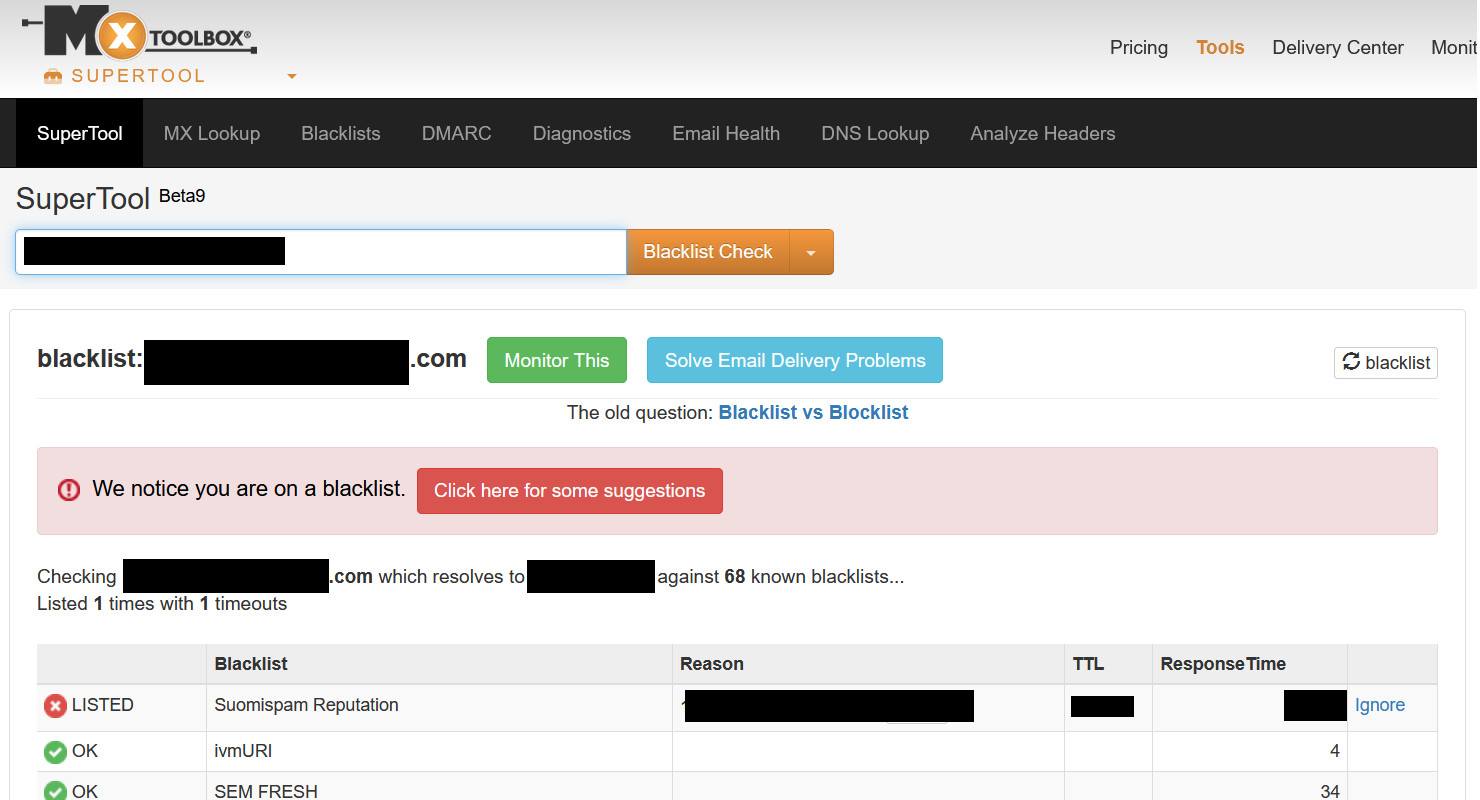
We hit this on a name we were evaluating for our own curated selection, not for a client. It cleared the brief: coined, no hyphens, no digits, and a clean preliminary trademark screen. We ran a mail blocklist lookup as a last pass, and the domain was already flagged as a spam source. We dropped it. A founder who had skipped that pass would have launched a brand whose transactional email lands in junk folders, then spent weeks blaming the email provider.
That check takes two minutes and it is the cheapest one in this article. Run every finalist through a public blocklist lookup before you pay for anything.
Step 5: Register the Alternative or Buy Brandable Domain Names Already Held
At this point the shortlist splits in two: names you can register today, and names somebody else already owns. This is a cost and timeline decision, not a branding one.
What works in practice:
- Registering an available alternative closes the question in an afternoon and leaves the budget with the product.
- Acquiring a held name gets you the exact word the brief asked for, which matters when the brand hangs on that word.
- An aftermarket purchase, meaning a name bought from its current owner rather than registered new, moves through escrow, a neutral third party that holds funds until the transfer completes.
Where this approach falls short:
- The second-best available name is sometimes second-best for a reason the founder feels every time they say it.
- An owner has no obligation to sell, to reply, or to name a price that relates to anything.
- Transfers between registrars run under ICANN's Transfer Policy, and lock conditions can delay a handover that everyone has already agreed to.
Market conditions and the seller's own position govern what an acquisition costs and whether it happens at all. We do not publish valuations of a reader's name, and we do not promise an outcome. Where a founder wants the approach handled for them, that is what our domain brokerage service is for. Trademark questions raised during an acquisition still belong with an attorney.
Final Decision: Is This Domain Ready to Register?
We run the finalist through the same order every time. A name that fails at any line goes back to the shortlist, not to the checkout.
- Brandable. Coined, compound or evocative, and able to function as a brand rather than a description.
- Pronounceable. Said once, understood once.
- Spellable. Written correctly by someone who has only heard it.
- Available or acquirable. Registrable today, or held by an owner you can actually reach.
- Preliminarily trademark screened. No obvious conflict in sound, appearance or meaning within a related class, with clearance left to an attorney.
- Historically clean. Registration record read, prior use and dispute history checked.
- Commercially suitable. The name still fits the business the brief described, and the cost of getting it fits the stage you are at.
Seven lines is not a formality. It is the difference between a name you register and a name you rebrand out of eighteen months later.
If your shortlist came up empty, or every finalist is already held, our curated selection is the faster route to a name that has already passed the first four lines above. Browse the DN Exposer brandable domain marketplace and see what fits the brief you just wrote.


