
You had a name. You typed it into a registrar search, the .com came back taken, and the shortlist you spent two weeks building collapsed in about forty seconds. What usually happens next is the part that costs money. The founder falls back on a long descriptive string that spells out the category, launches on it, and pays for a rebrand three years later when the company no longer does only that one thing.
The best brandable domain names examples we study with clients do not share a formula. They share a construction method and a set of trade-offs. A brandable domain is a name built as a brand asset rather than as a description of the product, and there are four ways to build one. Sort the examples by method and the shortlist problem becomes a solvable one.
What Makes a Domain Name Brandable?
A brandable domain name is a coined, compound or evocative word that identifies a company rather than describing its category. It is short, usually under twelve characters, pronounceable on first reading, free of hyphens and digits, and distinctive enough to function as a trademark. It carries no built-in ceiling on what the business can later sell.
That last clause is the one founders underweight. A descriptive name, sometimes called an exact match domain because the name matches the search phrase word for word, tells a visitor exactly what you do on day one. It also tells them exactly what you do on day one thousand, after you have added two product lines.
Brandability and legal protectability point in the same direction, which is convenient. The USPTO trademark process documentation is clear that registering a domain name does not by itself create trademark rights, and the Trademark Manual of Examining Procedure section on domain names treats the two as legally distinct things. Owning the name is not owning the mark. Clearance belongs with an attorney, not with a naming consultant and not with us.
25+ Best Brandable Domain Names Examples, Grouped by How They Were Built
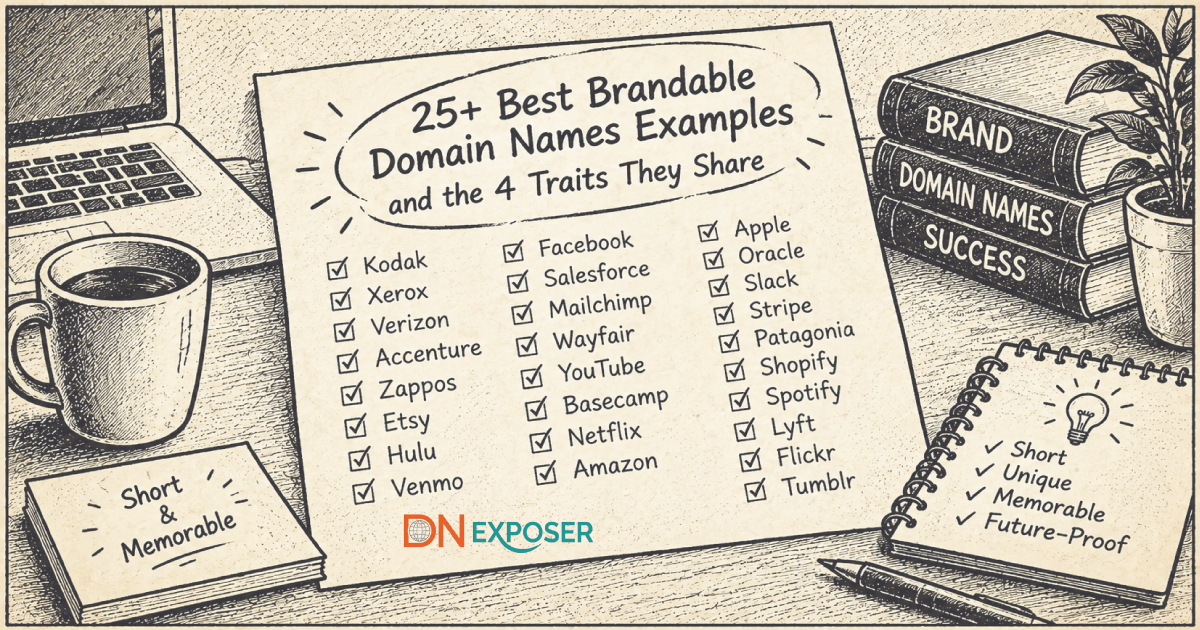
We grouped twenty-six names by the method used to make them, not by how much we like them. Every name below is a company operating on the .com of its own brand. We state no acquisition price for any of them, because we have no dated comparable sale to support one.
Coined Names Invented From Nothing
Kodak. Xerox. Verizon. Accenture. Zappos. Etsy. Hulu. Venmo.
A coined name is invented, so it carries no prior meaning and no prior owner. That is the whole argument for it. Nothing about the sound of Etsy or Hulu limits the company to a category, and four characters each means the name survives being read aloud over a bad phone connection.
The cost is that a coined word means nothing until you spend money making it mean something. We tell founders to price that in as a launch line item, not as a branding bonus.
Compound Names Built From Two Real Words
Facebook. Salesforce. Mailchimp. Wayfair. YouTube. Basecamp. Netflix.
Compounding is the availability strategy. Both halves are ordinary words that were unavailable alone, and joining them produces a string nobody had registered. Salesforce at ten characters and Basecamp at eight both stay inside the short range while telling a visitor something real.
Watch the seam. A compound works when the two halves fuse into one word on the page and fails when a reader has to stop and parse where the first word ends.
Evocative Names Borrowed From Another Domain of Meaning
Amazon. Apple. Oracle. Slack. Stripe. Patagonia.
An evocative name is a real word lifted out of its home context. It arrives with an association already attached, which is borrowed equity you did not have to build. Slack and Stripe both take a plain English word and let the contrast with the sector do the work.
The constraint is availability and it is severe. Single dictionary words on .com are almost entirely held, and acquiring one means dealing with an existing owner on an aftermarket, which is the secondary market for domains already registered. What that costs depends on market conditions and on the seller's own position, and neither is something a buyer controls.
Modified and Truncated Words
Shopify. Spotify. Lyft. Flickr. Tumblr.
Modification is the cheapest route to an available .com that still reads as a word. Drop a vowel, respell a sound, or bolt a suffix onto a common term. Lyft at four characters is a taken word made available by one letter.
Here is the trap we watch founders walk into. A respelled name has to be spelled every single time it is said out loud, forever, and that tax never goes away. We used to treat a dropped vowel as a clean win on any shortlist.
What Works in Practice: The Four Traits These Names Share
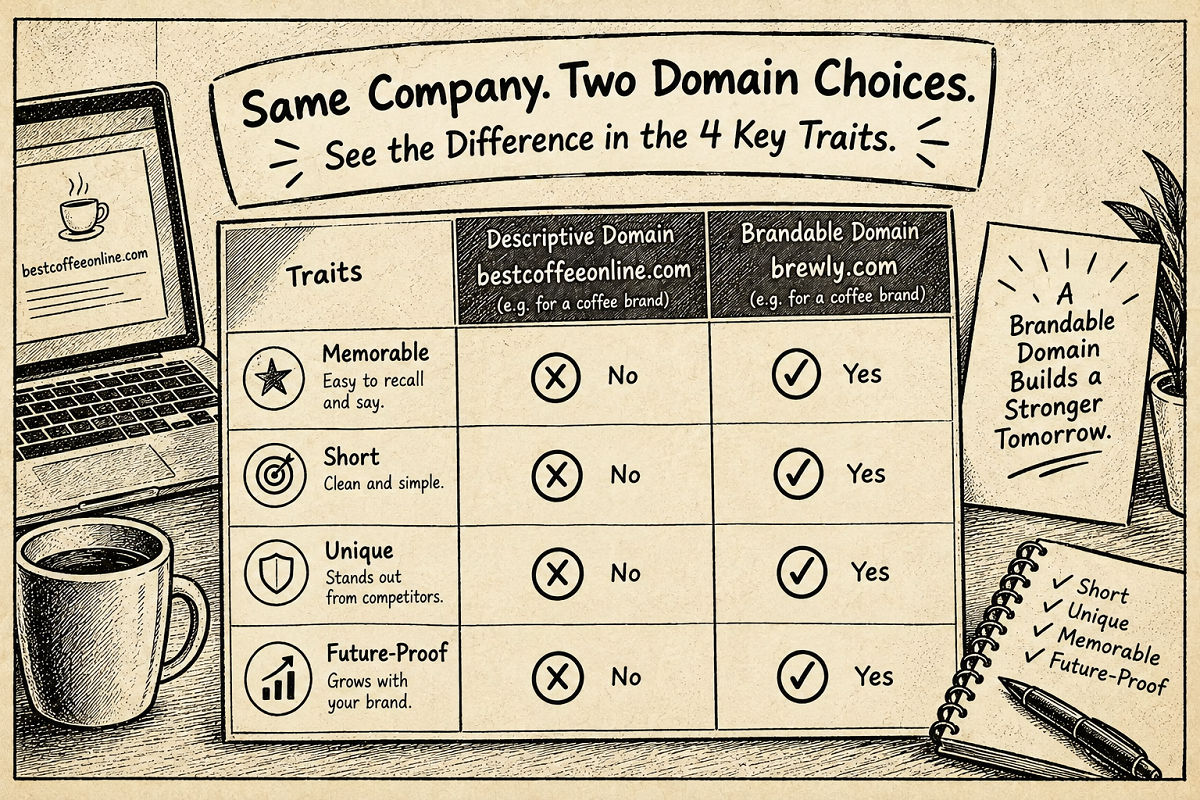
Cross the four groups and the same four traits appear in all of them. This is the answer to the characteristics of brandable domains question, and it is more useful than any list of favorites.
Easy to Say and Remember
Every name above survives the phone test: said once, spelled without hesitation, one to three syllables. Hulu, Slack, Lyft and Etsy all clear it in a single beat.
What works in practice:
- a name a customer can repeat to a colleague without a screenshot removes friction from word of mouth;
- short names fit the places that punish length, including app icons, email addresses and the side of a vehicle;
- one to three syllables keeps the name intact in spoken advertising and in voice search.
Where this approach falls short:
- the shortest and most sayable strings are also the most heavily registered, so the trait that helps you most is the one hardest to obtain;
- easy to say is not the same as easy to spell, and a respelled name fails the second test while passing the first;
- pushing for brevity alone produces names so generic they cannot be defended as marks.
Distinctive Without Being Difficult
Distinctiveness is where brandability and legal strength converge. A coined or arbitrary term sits at the strong end of the spectrum the USPTO uses to assess marks, while a descriptive term sits at the weak end. Accenture and Xerox are distinctive because they mean nothing else.
The limit is legibility. A name so unusual that a reader cannot decode it on sight has crossed from distinctive to difficult, and the two are not the same asset.
Flexible Enough to Grow With the Brand
Amazon sold books. Netflix mailed discs. Neither name had to change, because neither name described the mechanism. That is the practical case against locking a category or a city into a domain.
Flexibility is the trait first-time founders discount most and rebranding founders value most, and we have watched the same person move from one position to the other inside eighteen months.
Strong Enough to Stand on Its Own
A brandable name has to work with no supporting copy underneath it. No hyphens, no digits, and no reliance on a tagline to explain what the word is doing. Basecamp and Patagonia each carry meaning unaided.
Where Brandable Names Fall Short
We are not neutral on brandable names, but we are honest about what they cost. Three limits are real.
The first is demand. A coined name has no existing search demand attached to it, so early traffic has to be built rather than captured, and that is a budget question before it is a naming question.
The second is acquisition. The names that satisfy all four traits are largely registered already, which pushes a serious search onto the aftermarket, where price is governed by the market and by the seller's position rather than by any valuation you bring to the table. We promise no acquisition and no price.
The third is legal exposure. A distinctive name still has to clear the marks already registered in your sector, and registering a domain gives you no defense there. ICANN's Uniform Domain-Name Dispute-Resolution Policy sets out the process by which a trademark owner can challenge an abusive registration. That is a conversation for an attorney, before you launch and not after.
How to Find Brandable Domain Names of Your Own
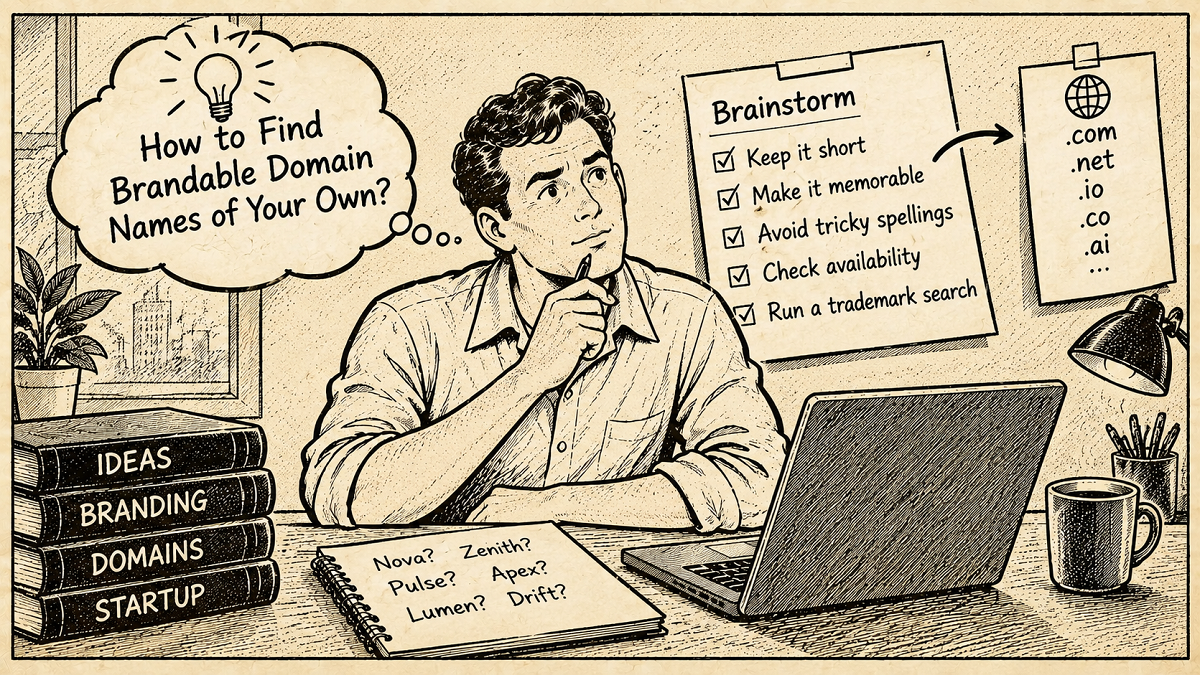
Turn the four groups into a working sequence. Generate candidates inside one construction method at a time rather than mixing all four, because mixing produces a shortlist with no internal logic and nothing to compare.
Say each survivor out loud to someone who has not seen it written. Anything that has to be spelled goes into a second tier, not into the bin, but never into first place. Then screen the remainder against registered marks in your sector before you check availability, because a name you cannot use is not a candidate however available it is.
Only then do you look at registration and transfer mechanics. One number is worth carrying into that stage: Verisign's Domain Name Industry Brief Quarterly Report puts the preliminary combined renewal rate for .com and .net at 75.2 percent for the second quarter of 2026. Close to one registration in four is not renewed, which is the mechanical reason names keep returning to the available pool, and it is why a candidate that is taken this month is not permanently out of reach. ICANN's information for domain name registrants covers what registration, renewal and transfer actually obligate you to do, and those obligations are the registrant's, permanently.
The full criteria sit in our complete guide to what makes a domain name brandable. The five-step screening method is in how to find brandable domain names for startups, and if you want to generate candidates faster, we reviewed the six categories of brandable domain name generator and what each one is actually good for.
If your shortlist keeps collapsing at the availability stage, the problem is usually the construction method, not the luck. We work through naming with founders directly: discovery, candidate generation inside a chosen method, screening and acquisition strategy. Request a brand naming consultation and bring the shortlist that failed. Evaluation covers the four traits above, sector distinctiveness and acquisition feasibility. Trademark clearance stays with your attorney.


